
The Unfinished Song Problem
What 413 musicians and listeners revealed about rough demos, trusted listeners, and the feedback that helps songs grow.
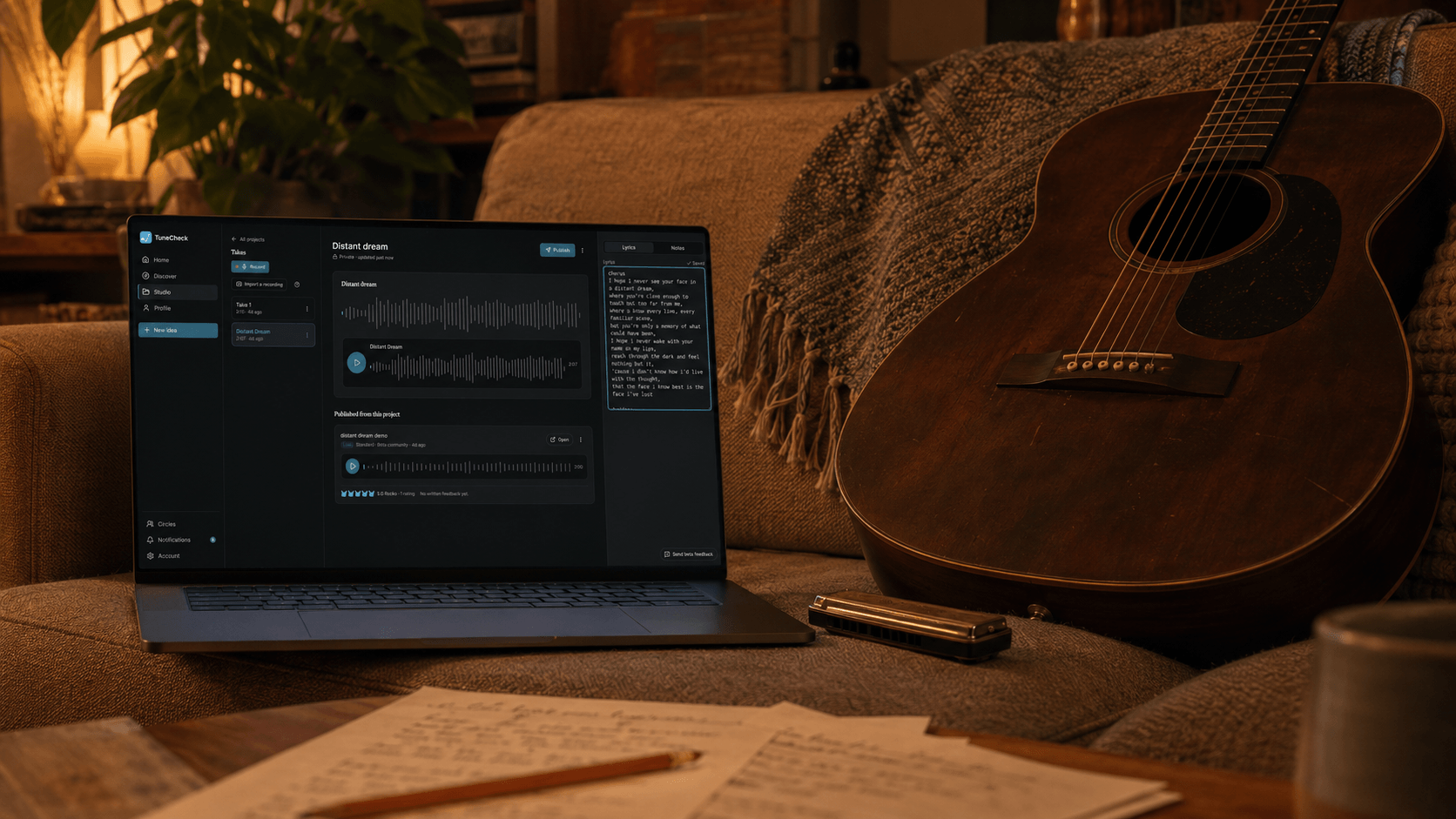
There is a particular kind of graveyard on almost every songwriter’s phone.
It is filled with voice memos named things like “new riff,” “chorus idea,” “maybe bridge,” and “song thing 47.” Some are eight seconds long. Others contain nearly complete songs recorded in a bedroom, rehearsal space, car, kitchen, or wherever the idea arrived before it disappeared.
Mine holds hundreds of riffs and melodies.
For years, I sent those recordings to bandmates through text messages and email. Sometimes the message was simple: What do you think of this? Sometimes it was more specific: Could this work as a chorus? Or: Can you learn this before practice?
The pattern became hard to ignore. The more often I shared an idea, the better its chance of becoming something larger.
A static homemade recording could turn into a full-band rehearsal. A guitar part could find a bass line. A melody could reveal the chorus it had been waiting for. Someone else could hear an opening that I was too close to the song to notice.
The recording did not need to be finished. It needed somewhere to go.
That realization became the beginning of TuneCheck.
The distance between capturing an idea and finishing it
Recording music has never been more accessible.
A songwriter can capture a usable idea with a phone. A laptop can become a multitrack studio. Interfaces, microphones, instruments, effects, and production software can travel in a backpack. We are writing in bedrooms, on tour, between rehearsals, during lunch breaks, and wherever else inspiration decides to interrupt us.
The bottleneck is no longer simply recording the idea.
The harder question is what happens next.
Which riff deserves another hour? Does the chorus lift enough? Is the quieter version more convincing? Should the bridge arrive earlier? Is there a song inside this recording, or is it only a moment?
When you write constantly, some ideas inevitably take the back seat. That does not always mean they are weak. Sometimes they lack context. Sometimes they need another musician. Sometimes they need a listener to identify the ten seconds worth pursuing.
And sometimes the person who wrote the idea has heard it too many times to know what is working anymore.
Was this only my problem?
Before building TuneCheck, I wanted to know whether other musicians and listeners recognized the same gap.
I surveyed 413 people about unfinished music, songwriting habits, collaboration, feedback, and the idea of hearing songs before they became polished releases.
The questions were not framed around streaming numbers or promotional reach. They focused on the creative middle, the period when a song exists but can still become something different.
One question asked:
Imagine your favorite musician just wrote a rough version of a new song. Would you like to be among the first to hear it and engage through voting, comments, or other feedback?
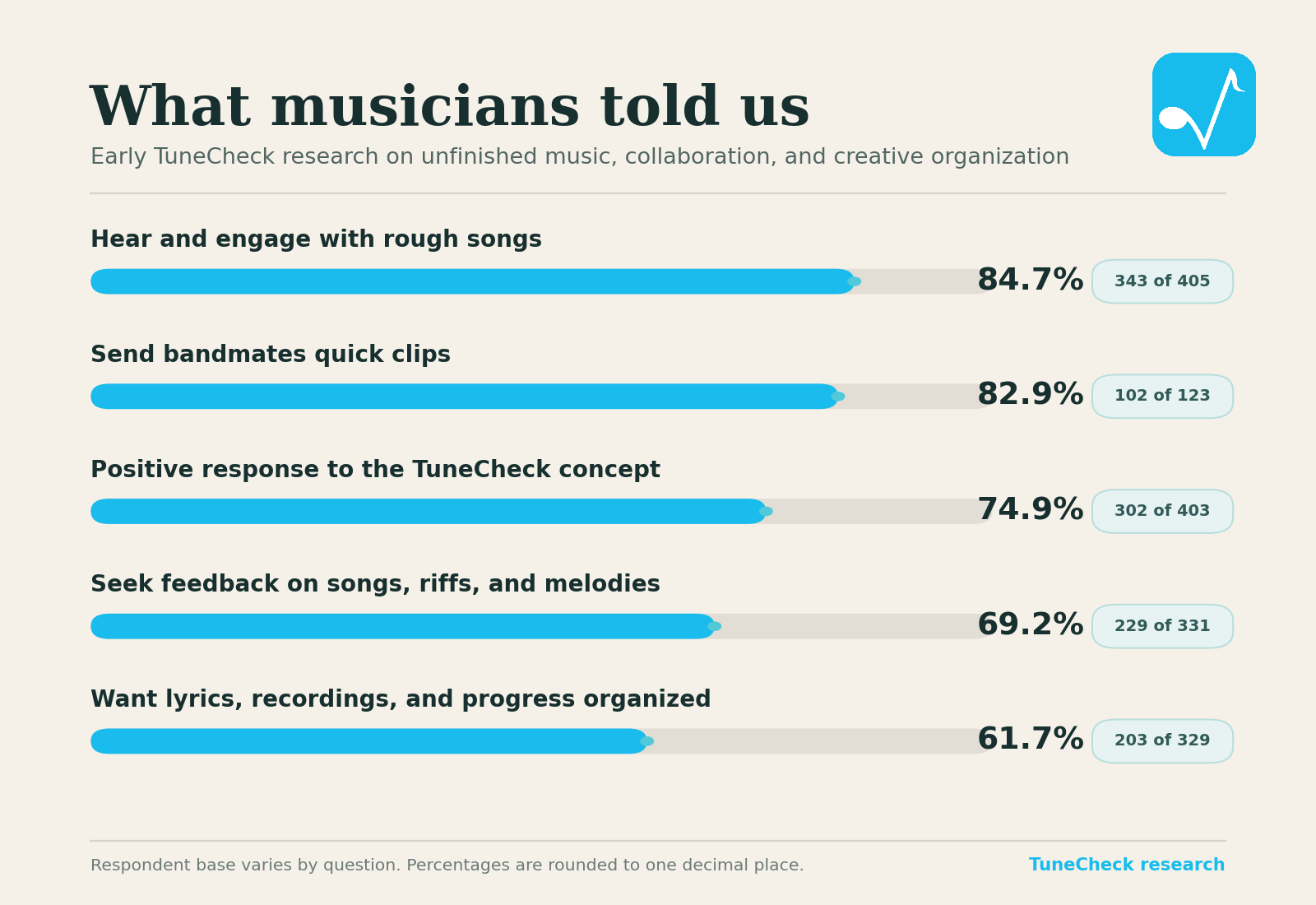
Of the 405 people who answered, 84.7% responded positively.
That was one of the clearest signals in the research. Listeners were not only interested in finished releases. Many were curious about the decisions, experiments, and imperfect recordings that came before them.
Another question asked musicians:
How likely are you to ask friends or family members for feedback on new songs, riffs, and melodies that you write?
Among the 331 people who answered that question, 69.2% said they were likely to do it.
The behavior already existed. It was happening in texts, emails, rehearsal rooms, direct messages, and conversations with trusted listeners. The missing piece was a place designed around that exchange.
The survey also asked respondents to select statements that applied to their songwriting process. Among 329 respondents:
- 61.7% wanted an app that could organize lyrics, recordings, and songwriting progress.
- 52.3% were interested in involving friends or fans in the songwriting process.
For musicians working with a band, I asked a particularly practical question:
How likely would you be to send your bandmates a quick clip of a new song so they could practice outside of rehearsal?
Of the 123 people shown that question, 82.9% said they were likely to do it.
Finally, respondents were shown the original TuneCheck concept: a platform where musicians could get peer feedback on new songs, riffs, and melodies in progress while listeners could hear and respond to developing music.
Of the 403 people who answered, 74.9% reacted positively.
What the numbers actually meant
The research did not say that every musician wanted to release unfinished music to the entire internet.
That distinction matters.
For many songwriters, rough recordings are vulnerable. They may contain placeholder lyrics, missed notes, unfinished arrangements, or ideas that are still too personal to explain. Famous demos often appear only after the finished song has succeeded, when the rough edges can be heard safely in hindsight.
There is a reason for that.
Sharing too early, with the wrong audience or without a clear question, can flatten an idea before it has had time to develop. A vague reaction such as “I don’t like it” offers very little. A public score without context can feel more like judgment than help.
The research suggested something more useful: musicians wanted feedback, but the audience and setting mattered.
That insight eventually became Listening Circles.
Not every TuneCheck is published to the wider Beta community. A musician can create a private Listening Circle for bandmates, collaborators, producers, managers, or a handful of trusted listeners. The creator chooses who can hear the music.
A songwriter might ask a bandmate whether a riff leaves enough room for the vocal. A band could share a new arrangement before rehearsal. An artist might ask a manager or producer whether a particular song deserves more attention. Two versions of a chorus, melody, mix, or arrangement can be placed head-to-head in an A/B TuneCheck.
The point is not to hand creative control to a crowd.
The point is to ask the right people the right question while their answer can still make a difference.
What are critics actually for?
Music criticism has traditionally arrived downstream.
A record is finished. The rollout begins. Critics listen, interpret, contextualize, and evaluate what the artist has released. In doing so, they help create a record of how music was understood in its moment.
The introduction to The Cambridge History of Music Criticism describes music criticism as an influential part of music history. Critical writing has not merely handed out verdicts. It has documented performances, movements, changing tastes, and how music sounded to the people hearing it at the time.
TuneCheck moves a version of that attention upstream.
Instead of asking only, Was this song good?, it gives the creator room to ask:
- Does the chorus lift enough after the quiet verse?
- Which arrangement makes the lyric land harder?
- Is the guitar competing with the vocal?
- Does this melody feel resolved?
- Which of these two versions should we keep developing?
That is the difference between a verdict and useful feedback.
Research outside music offers some support for the broader principle. A study of 456 employee and supervisor pairs found that directly asking for feedback was associated with stronger evaluations of creative performance. The researchers described feedback-seeking as a resource for achieving creative outcomes, not merely a way to conform. This was a workplace study, not a songwriting experiment, but the creative pattern is relevant: people can use feedback to find their next move. Read the study in the Academy of Management Journal.
The environment matters, too. Research published in Frontiers in Psychology found that a supportive feedback environment influenced creative performance through changes in affect. In plain language, feedback does not exist separately from how it is delivered or how safe the recipient feels receiving it. Read the research on feedback environments and creative performance.
That is why TuneCheck is not built around a single upvote or downvote.
A downvote is a door closing. It tells you almost nothing about what the listener heard.
TuneCheck uses a one-to-five rock rating, so the floor is still a rock, not rejection. More importantly, the rating sits beside a focused question and space for actual feedback. The number is a signal. The explanation is where the value lives.
A dedicated place for music that is still becoming
Musicians already share unfinished work online.
Reddit threads, music forums, group chats, social platforms, and creator communities contain a constant stream of demos, riffs, mixes, and requests for feedback. Reddit in particular has built remarkable communities around open conversation and, when people want it, anonymity.
TuneCheck is not meant to erase those communities.
It is meant to provide a dedicated space for the specific moment when a musician says, Here is what I am working on, and here is what I need help hearing.
A general-purpose thread is not designed to keep recordings, takes, lyrics, notes, questions, versions, and feedback connected to the same developing song. The post eventually moves down the feed. The conversation becomes difficult to find. The next version starts somewhere else.
TuneCheck keeps the work together.
You can also participate under the level of public identity that feels right for you. The quality of a musical observation does not depend on whether the listener has built a personal brand.
What matters is that the feedback is human, relevant, and given with some awareness that an unfinished song is not a failed finished song.
It is a different kind of object.
A place for the next step
TuneCheck follows the natural movement of a developing song:
- Capture the idea. Record something in TuneCheck or bring in a recording you already made.
- Keep the work together. Organize takes, lyrics, notes, and the song’s progress in one private creative space.
- Choose the moment that matters. Select the exact section you want someone to hear.
- Ask one focused question. Tell listeners what you are deciding instead of asking for a vague opinion about the entire song.
- Choose the audience. Share privately with a Listening Circle or publish to the wider TuneCheck community when you want broader feedback.
- Bring the feedback back into the song. Use what you heard to revise, rehearse, compare another version, or decide that the original instinct was right.
The goal is not to turn songwriting into a referendum.
It is to give ideas more chances to move.
Human music in progress
We have reached a strange and exciting moment in music creation.
I have experimented with AI tools. I have used them for inspiration, tested generated ideas, and let robots offer lyrics that I could pull apart and riff around. TuneCheck is not an anti-technology purity test.
But the easier it becomes to generate something that resembles a finished result, the more valuable the human creative process becomes.
A person hears something that does not exist yet. A hand finds a chord. A voice reaches for a melody. A mistake becomes the most interesting part of the recording. Another musician hears a direction inside it. The song changes.
“Human music in progress” is TuneCheck’s way of protecting that space.
It does not mean every recording must be untouched by technology. It means the human being remains at the center of the decision. The artist chooses what to pursue, what to discard, who to trust, and when the work is ready to leave the room.
Perfection is not the entry requirement.
In fact, imperfection is often the point.
TuneCheck is a place to concentrate creative energy before it gets buried under polish, performance, promotion, and the pressure to present everything as complete.
Your idea does not need to prove that it is already a song.
It only needs a chance to become one.
An ode to the music note
The TuneCheck symbol sits somewhere between a music note, a waveform, and a line that is still being drawn.
To me, the dot represents the beginning: the first sound, riff, lyric, beat, or melody worth capturing.
The line moves because the idea is not static. It dips, rises, changes direction, and reaches upward. It is a song becoming more than the recording that first contained it.
That is the entire idea of TuneCheck in one mark.
Start with something small. Keep it moving.


The listeners are ready
Listeners now have extraordinary influence over which songs travel, which artists break through, and which sounds become part of the culture.
TuneCheck asks what might happen if some of that attention arrived earlier and more thoughtfully.
Not to dictate the song.
Not to replace the songwriter.
Not to make every unfinished recording public.
Just to help a good idea find its next step.
The research began with questions about rough songs, band practice, creative organization, and whether listeners would care about music before it was finished.
The answer was clear enough to keep building.
Now TuneCheck is here.
About the research
TuneCheck collected 413 responses from musicians and music listeners during its original concept phase in May 2014.
The research was exploratory and self-selected, not a nationally representative study of all musicians or listeners. This article highlights the findings most relevant to the current TuneCheck product while acknowledging that comfort with sharing unfinished music varied significantly by person and audience.
Comments
Join the conversation. Sign in or create a free TuneCheck account to leave a comment.